
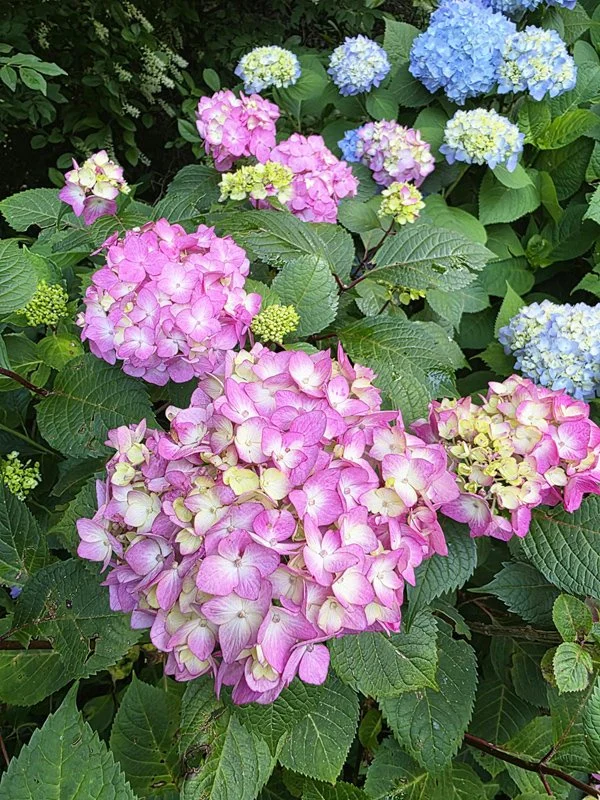
Hydrangeas symbolize heartfelt emotions, gratitude and graceful abundance - Anonymous
On a typical sunny June morning, I visit a grove of macrophylla hydrangeas in my yard as they soak up the gentle light. It is a treat to walk among these handsome shrubs to admire buds and blooms that increase in beauty with each passing day. In the morning, the light is filtered through the forest beyond my creek and there is abundant dew on the grass and the plants. I listen to the flowing water and I am filled with gratitude that I can enjoy this experience every spring.
Macrophylla hydrangeas are reliable perennials. Over the years, I have planted many different hydrangea varieties in my yard that always produce an array of harmonious colors, such as blue, lavender, pink and white. These plants are the stars of June in Western North Carolina. They come out of dormancy in March, when they begin producing tiny leaves. By April and May, small buds appear on stalks that have been bare all winter, followed by abundant and globular blooms that are visible everywhere in late spring. The flowers continue to open throughout the month of June.
So Many Varieties For Your Garden
Hydrangea varieties have many different popular names, such as Bigleaf, French and Mophead, though all are also known by their scientific name, Hydrangea macrophylla. A unique hydrangea with a different style bloom is the Lacecap, known as Hydrangea macrophylla normalis. Its delicate blooms are flatter, with a ring of flowers around a center of smaller flowers. Both kinds of hydrangeas need partial shade to full shade to thrive; they cannot tolerate full sun. Morning light is best, so plan carefully when you plant.
The word macrophylla is from the Greek makros for large and phyllon, meaning leaf, to describe the plant's large, handsome foliage. The word hydrangea is also Greek, from hydro for water and angeion for vessel, describing a water vessel. Hydrangeas love to absorb water, especially on a hot day.
Over the years, plant breeders have created thousands of cultivars of macrophylla hydrangeas, offering many choices of blooms, ranging from white to light blue, deep purple and many shades of pink. I enjoy combining these colorful blooms in my flower arrangements.
A Beloved Plant in Japan
The hydrangea is originally a native of Asia, especially Japan, Korea and China. The Japanese in particular regard the hydrangea as symbolizing love, repentance and gratitude. According to Japanese legend, an emperor gave blue hydrangeas to the woman he loved. He felt he had neglected her, so he apologized with the gift of beautiful hydrangea blossoms. Since then, hydrangeas have symbolized heartfelt feeling to the Japanese. Many temples, shrines and gardens are full of hydrangeas that bloom in June and July, reflecting Japan's reverence for this plant.
With the Summer Solstice approaching, macrophylla hydrangeas are growing and blossoming at a tremendous rate. June is a wonderful month with perfect gardening weather. This is the time when these plants are at their best.
Judith Canty Graves is an award-winning columnist with a home garden in Asheville. Follow @TheObservantGardener on Instagram to see new garden photos daily. This article appears in The Laurel of Asheville magazine.
